
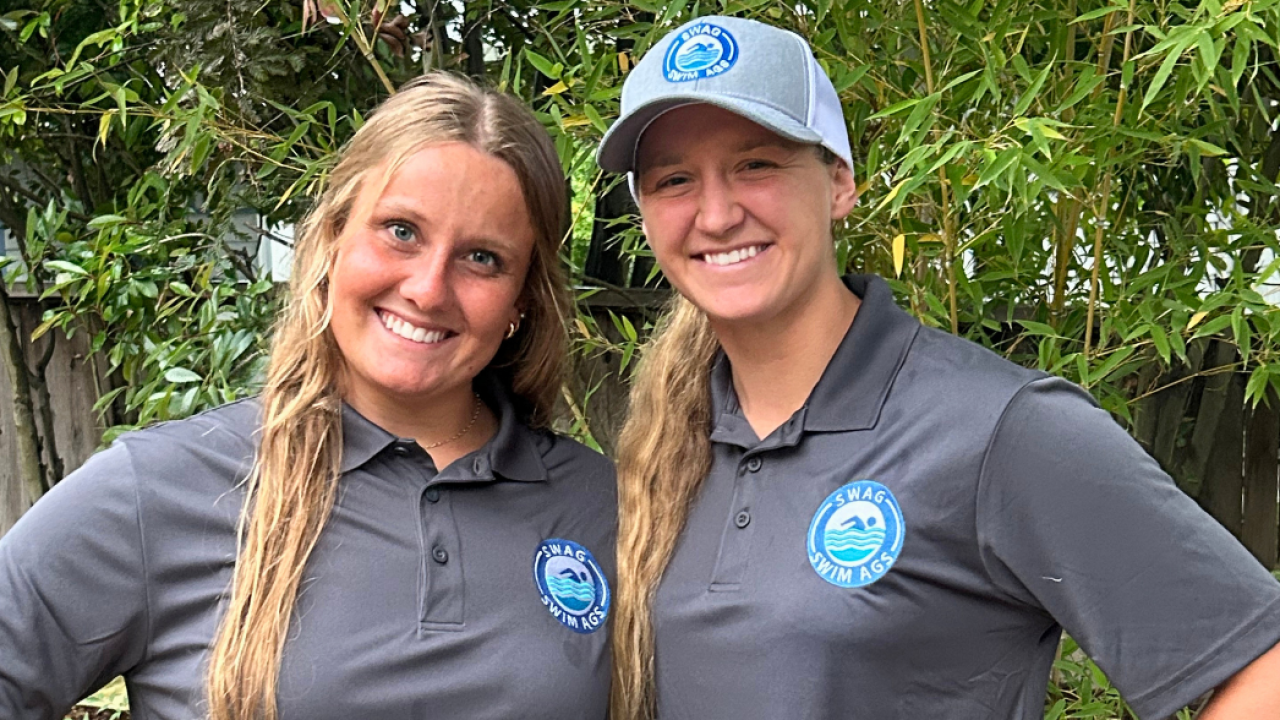
Lillie Vehling and Sadie Henry are turning their passion and lifelong connection to the water into something bigger than sport. Vehling, a double major in aerospace and mechanical engineering, and Henry, who studies neurobiology, physiology and behavior with a minor in public health, are channeling their experiences into SWAG, or Swim Ags, a project aimed at closing a critical gap in water safety education while building a stronger sense of community on campus.
For the two Division I water polo athletes, water has been a defining part of their lives. After more than a decade in the sport, they recognized something that many overlook: a widespread lack of water safety skills, especially among adults.
“Water safety isn’t just a want, it’s a need,” Henry said. “The lifestyle we’ve learned from water polo means that we have so much to give and so much to inspire other people.”
Their experiences as athletes, combined with training from top coaches and certifications from American Red Cross in lifeguarding and USA Swimming in adult swim instruction, gave them both the skills and confidence to act. SWAG was born not just out of passion, but out of responsibility — to share knowledge that can ultimately save lives.
HOW TO REGISTER
- REGISTRATION: Open now for UC Davis community. SWAG is also accepting volunteer signups.
- COST: Free
- WHEN: April 19, 1-3 p.m.
- WHERE: Davis Community pool
“There've been a lot of incidents especially in college communities due to the convergence of so many diverse people from different backgrounds and availability to pool water education,” Vehling said.
At its core, SWAG is more than just learning to swim. They are focused on building a community that is safe and welcoming for all, both physically and emotionally.
“When you're at a pool, you’re always with people and very rarely individually swimming or enjoying the water,” Vehling said. “So community and safety go hand in hand.”
SWAG’s teaching model is intentionally designed for impact. With a 3:1 participant-to-instructor ratio, each session prioritizes individualized attention and comfort. Before stepping into the water, participants are asked to fill out a survey that would allow the instructors to gauge their skill level, fears, experiences and goals. From there, individuals are grouped based on skill level and lessons are tailored accordingly.
The small group also allows the instructors to get feedback from the participants, helping them improve their lessons.
For many adults, they say, the biggest hurdle isn’t swimming but it’s simply getting in the water.
“Our main goal is teaching them how to swim with your head in the water,” Henry said. “Once they do that, they can do anything.”
One of SWAG’s most important decisions was making the sessions free. Traditionally, swim lessons run up to $90 an hour, an expense that puts learning out of reach for many. SWAG aims to fill that gap by making it accessible to the UC Davis community, ensuring people have a chance to learn about water safety.
“Finances shouldn’t be a factor in water safety,” Henry said. “It’s purely a lifesaving skill.”
To make this possible, the program relies on grants, scholarships and support from initiatives like the Engaged Athlete Fellowship, which promotes civic engagement among student-athletes.
The first clinic, scheduled for April 19 at the Davis community pool, marks just the beginning.
SWAG’s long-term goals include expanding sessions throughout the quarter and scaling to other college campuses, with a broader aim of reducing water-related fear and preventing drownings nationwide.
“This is a common issue across the U.S.,” Henry said. “If we could expand SWAG and help lower the percent of drownings, I think that's the start to something really great.”
Launching a service project while balancing academics and athletics is no small feat. Between demanding coursework and training, they juggle packed schedules that require discipline and precision. Yet, their mindset — shaped by years of high-level athletics — drives them forward.
“It’s not easy,” they both admit. “Every minute of your day has to have some value,” Vehling said.
Ultimately, SWAG is about transformation, helping individuals move from fear to confidence and from isolation to community. For participants, success might look like swimming across the pool. Or it might simply mean stepping into the water for the first time.
And for the founders, that’s what matters most: creating a space where people feel seen, supported and capable of more than they thought possible.
“We love what we do,” Vehling said. “That's probably one of the biggest things that carries me through each day.”
Media Resources
Anila Lijo is a writer and editor for the Office of Strategic Communications, and can be reached by email.